Mobile whiteboards can turn a spare corner, meeting room, or training area into a useful collaboration space. Yet choosing one involves more than comparing prices or picking the largest writing surface. The right model should fit the way your team works, move safely across your floors, and remain easy to use after a busy week. Small details matter. A frame that feels stable on carpet may roll poorly over doorway thresholds. A board that looks spacious online may crowd a narrow room.
Before purchasing, consider who will use the board, where it will travel, and what it needs to support. Measure doorways and storage spaces, then compare board dimensions, total weight, wheel locks, height adjustment, and surface compatibility with your markers and erasers. Check whether the writing area is magnetic, double-sided, or designed for frequent cleaning. These features affect everyday use, not just the product listing. Ask about assembly, replacement parts, warranty coverage, and cleaning guidance; reliable product information is worth more than a vague promise. There is no single best choice. Some teams need quick movement between rooms, while others value a broad surface that stays put. And, honestly, teams sometimes overlook storage until the board arrives. The outline below explains how to weigh these practical factors, compare options, and choose mobile whiteboards that suit your workspace and budget without relying on appearance alone. One caveat: specifications cannot predict every hallway or workflow. Test it first.
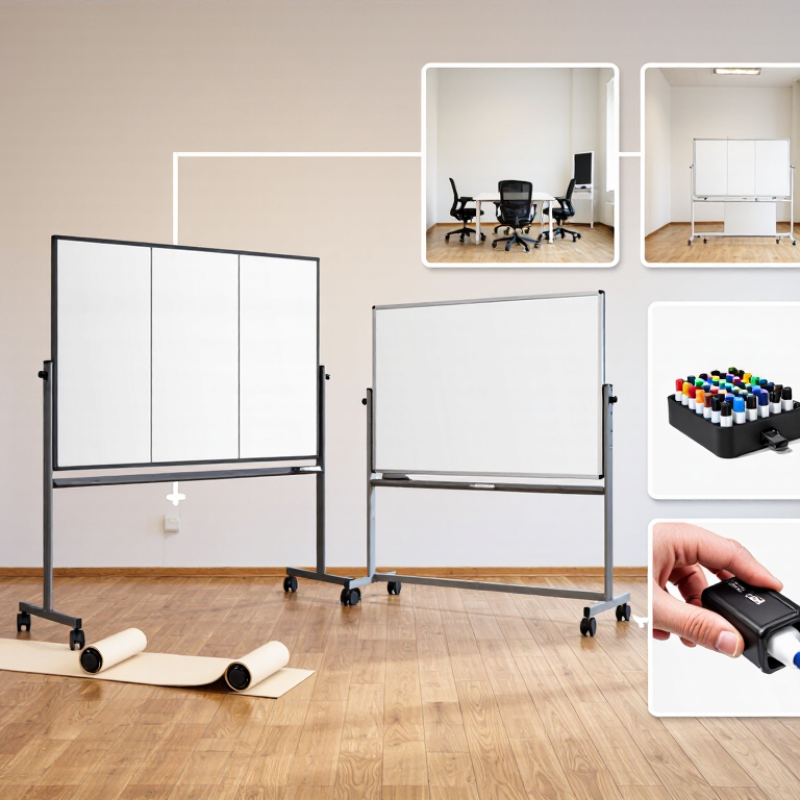
A mobile whiteboard is a writable surface on a wheeled frame, often with a double-sided board or magnetic face. Unlike a wall-mounted board, it can move between meeting rooms, training areas, and project teams. In business, people use it to map customer journeys, sketch process changes, sort ideas into columns, or track decisions during a stand-up. The value is practical: someone can roll the board beside a table, draw a workflow, and invite colleagues to edit it in real time. Harvard Business Review has reported that employees in many organizations spend about 80% of their work time collaborating. A visible, movable workspace can support that activity, though it cannot make an unclear meeting useful. It’s just a tool.
Tips: Check wheel locks, board height, and writing-surface glare before buying. Choose a size that fits through doorways and leaves room for people to gather. For shared spaces, test whether markers erase cleanly after a full day. Small detail. Easy to overlook.
For hybrid teams, a mobile whiteboard can anchor an in-room discussion, but remote colleagues may not see fine writing. Add a camera view or transfer key notes to a shared digital document. Keep the board near the group, not across the room. And leave space for unfinished thoughts; neat diagrams can hide uncertainty. A board should invite questions, not just display a polished answer.
Before comparing mobile whiteboards, map how your team actually works. Microsoft’s 2023 Work Trend Index, based on 31,000 workers across 31 markets, found that 68% lacked enough uninterrupted focus time. That is not a whiteboard statistic; it does highlight the need to separate quiet planning from live collaboration. Ask who meets, where ideas stall, and whether people need to move boards between rooms. Count actual use.
Observe a typical week. Do people sketch project timelines in short stand-ups, or review detailed workflows with small groups? A narrow board may suit a two-person huddle, while a larger surface gives several colleagues room to add notes without crowding. Check door widths, lift access, and storage space before choosing a frame. A board that cannot pass the meeting-room doorway is a costly oversight.
Also consider writing habits. Frequent marker use calls for an easy-clean surface; pinned cards or printed diagrams may require a magnetic face. Lockable wheels help keep the board steady during discussion, though teams may forget to lock them. We often guess wrong. Test a sample in a real meeting, then ask users what felt awkward. Their answers may change the size, surface, or mobility you thought you needed.
Mobile whiteboards come in several practical formats: single-sided panels, reversible boards, and combination boards with a writing face on one side and a pinboard on the other. Reversible models suit quick team huddles; locking casters keep them steady when someone writes. Check the frame width and door clearance, too. A board that cannot reach the meeting room is not very mobile.
Surface choice changes the feel of daily use. Porcelain enamel on steel is magnetic and handles frequent erasing well, but it can make a large board heavier. Melamine is usually lighter and economical; without a steel backing, it will not hold magnets and may ghost sooner under heavy use. Glass resists staining and wipes clean, though glare can obscure pale marker lines. Test it under your room’s actual lighting. Keep it simple.
A 2023 Work Trend Index report found that 68% of surveyed workers lacked enough uninterrupted focus time. A mobile board can help teams make ideas visible without reserving a fixed room, but it is no cure for crowded schedules. For shared spaces, check marker compatibility, replacement parts, wheel locks, and whether the writing surface sits at a comfortable height. One detail is easy to miss: some magnetic surfaces need stronger magnets than expected. Try your own notes and magnets before ordering several units.
Compare common mobile formats by the number of usable writing faces. Surface choices include melamine, painted steel, porcelain-on-steel, and glass; magnetic capability depends on the board’s construction.
A single-sided board provides one writing face. Double-sided and reversible or rotating boards provide two. Choose a surface based on your need for magnetic use, durability, and budget.
Choose a mobile whiteboard by mapping its route, not just its meeting room. Measure doorways, lift interiors, and tight turns before selecting a base. The 2023 Work Trend Index reported that 68% of surveyed workers wanted more uninterrupted focus time. A board that rolls between rooms can support quick, low-disruption planning, but only if its wheels lock firmly and its frame stays steady.
Size should match the work. A compact board suits small huddles; larger teams need enough writing area for headings, diagrams, and notes without crowding. Check the usable surface, not only the outer dimensions. For durability, inspect the frame joints, corner protection, wheel quality, and tray attachment. Ask suppliers for documented cycle or stability testing, and compare it with ANSI/BIFMA X5.5 test criteria where applicable. That standard covers certain office products, not every whiteboard configuration, so request product-specific evidence.
Accessories matter. A full-width marker tray, magnetic surface, and clip-on paper holder can make sessions easier to run. Test whether markers erase cleanly after notes sit overnight. Small detail. I would also check replacement parts and cleaning guidance; these are easy to overlook, and surface performance can vary with marker type and maintenance.
Choose a mobile whiteboard by measuring its parking spot, not just its writing area. Check doorways, lift access, and the space needed to turn it beside a table. A 90-by-120-centimeter board may look compact online but can crowd a narrow meeting room. Locking wheels matter when people write; smooth wheels matter when teams rearrange rooms. Both matter.
Budget for more than the purchase price. Compare the frame, wheel quality, usable writing surface, replacement parts, and cleaning needs. A magnetic surface may cost more, but it can hold printed schedules without tape. Microsoft’s 2023 Work Trend Index found that 73% of employees wanted a better reason to come into the office, while 84% said socializing with coworkers would motivate them. A shared board can support that interaction, but only if people can gather around it comfortably.
Test the board at full height and roll it over the actual floor. Does it wobble? Can someone at the back read the writing? I once focused too much on board size and overlooked a tight storage corner. Not ideal. Leave room for markers, erasers, and a clear path around the board; otherwise, a bargain purchase may become awkward office furniture.
| Mobile Whiteboard Option | Typical Board Size | Approximate Rolling Footprint | Typical Planning Budget (USD) | Workspace and Mobility | Best Fit | Points to Check |
|---|---|---|---|---|---|---|
| Compact, single-sided board | 24 × 36 in (61 × 91 cm) | About 24–30 × 18–24 in (61–76 × 46–61 cm) | $100–$300 | Easy to move through tight rooms and store when not in use. Offers limited writing space. | Small offices, individual work areas, and quick one-to-one discussions. | Check wheel locks, frame stability, and whether the writing surface is large enough for your typical sessions. |
| Standard, single-sided board | 36 × 48 in (91 × 122 cm) | About 36–42 × 20–28 in (91–107 × 51–71 cm) | $150–$450 | A practical balance of writing area and maneuverability for many meeting rooms. | Small teams, huddle rooms, and shared office spaces. | Allow clearance for the base and for people to stand and write comfortably around the board. |
| Reversible, double-sided board | 36 × 48 in (91 × 122 cm) | About 36–44 × 22–30 in (91–112 × 56–76 cm) | $250–$700 | Two writing surfaces increase capacity without requiring a larger board area; the pivoting frame needs turning clearance. | Training rooms and teams that need to keep one set of notes visible while working on another. | Confirm that the locking mechanism secures the board during use and that there is enough space to rotate it safely. |
| Large, reversible board | 48 × 72 in (122 × 183 cm) | About 48–56 × 24–34 in (122–142 × 61–86 cm) | $350–$1,000 | Provides substantial writing space but can be harder to steer and may not fit through narrow doorways. | Large meeting rooms, workshops, and group planning sessions. | Measure doorways, corridors, elevators, and storage locations; check product weight and caster capacity. |
| Extra-large, reversible board | 48 × 96 in (122 × 244 cm) | About 48–56 × 26–36 in (122–142 × 66–91 cm) | $500–$1,500 | Offers the greatest writing area in this comparison, but requires generous turning, parking, and storage space. | Training centers and spacious conference rooms with frequent group use. | Check the assembled dimensions, route from delivery entrance to room, stability, and whether the board can be parked without blocking exits. |
| Budget figures are approximate planning ranges for complete mobile units in the U.S.; actual prices vary by construction, surface, accessories, shipping, and seller. Footprints are illustrative ranges because frame and caster designs differ. Confirm the manufacturer’s assembled dimensions and measure the room and delivery route before purchasing. | ||||||