Choosing the right reception area desks in 2026 requires more than attractive photographs and polished product descriptions. Global buyers must evaluate visitor flow, workplace culture, material performance, accessibility, delivery conditions, and long-term maintenance. A desk that looks elegant in a showroom may feel cramped beside a security gate or fail under daily cleaning routines.
Dieter Rams, a leading industrial designer, offered a useful principle: “Good design is as little design as possible.” That idea still matters here. The strongest reception area desks often combine quiet visual form with practical details, including cable access, durable laminates, rounded corners, and discreet storage. Small details matter.
This guide compares solutions for offices, hotels, healthcare facilities, education spaces, and corporate headquarters. It considers global purchasing concerns, such as modular sizing, packaging quality, replacement parts, fire-performance documentation, and communication with overseas suppliers. Product standards differ by region, so buyers should verify technical documents locally before placing an order.
Experience also reveals an uncomfortable truth: the most expensive desk is not always the most suitable. Some budget models age poorly, while carefully specified mid-range desks perform for years. Measurements can also mislead. A 2,400-millimeter counter may appear spacious, yet leave insufficient clearance for wheelchairs or visitor queues.
The following recommendations focus on balanced decisions. Appearance matters, but so do ergonomics, installation risk, staff comfort, and future adaptability. Expect useful comparisons, not perfect answers. Real projects always contain compromises.
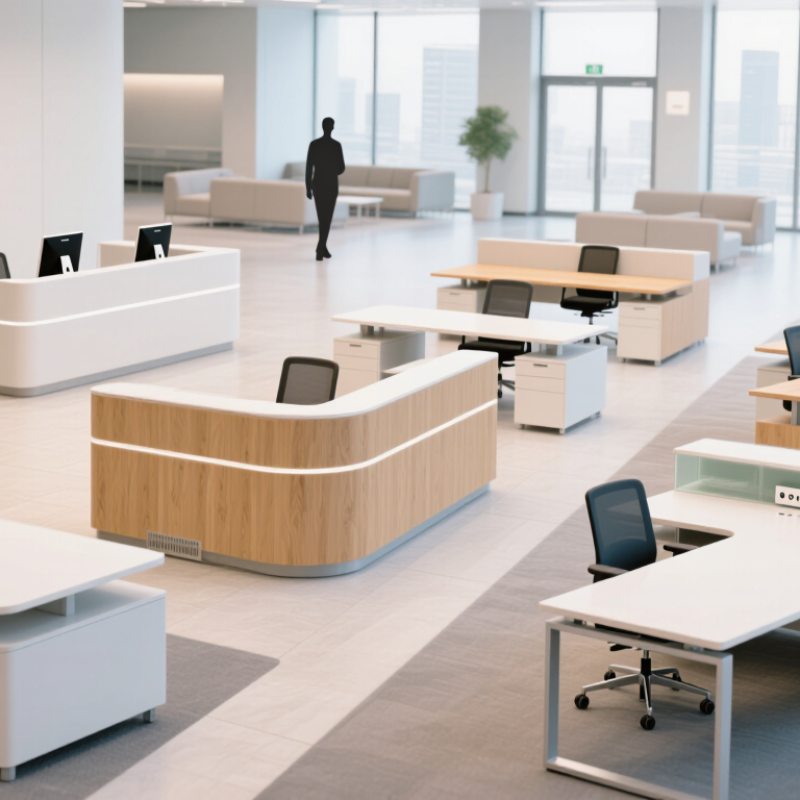
Reception areas are changing from formal waiting zones into active workplace gateways. Global buyers now seek desks that support visitor registration, security screening, parcel handling, and short employee meetings. Grand View Research valued the global office furniture market at approximately USD 58 billion in 2023. It projects growth near 5% annually through 2030. Reception desks should benefit from this wider demand, although public market data rarely isolates reception furniture.
Demand differs by building format. Corporate headquarters prefer wide, low-profile counters with concealed cable routes and integrated accessibility features. Clinics and serviced offices often need compact, cleanable surfaces. Hotels and education facilities may require stronger impact resistance and clearer wayfinding. JLL’s 2024 Future of Work survey reported that many organizations are investing in better workplace experience. That shift makes the reception desk part of an operational system, not just a decorative fixture.
Buyer segments also influence specifications. Large enterprises usually request modular layouts, replaceable panels, and documented material performance. Small offices often prioritize delivery speed and simple installation. Public-sector buyers may require formal testing records and transparent sourcing information. The International Facility Management Association continues to emphasize lifecycle planning in facility decisions. That matters here. A cheaper desk can become expensive after repeated repairs, difficult cleaning, or staff discomfort. Yet larger is not always better. Some projects still overdesign the counter and leave too little circulation space. Measurements should begin with real visitor flow, wheelchair turning areas, monitor height, and local building requirements.
For 2026 reception area planning, the ADA 2010 Standards offer a useful access benchmark. At least one accessible transaction surface should not exceed 36 inches above the finished floor. This height supports many wheelchair users during check-in, document signing, and brief conversations. It also helps visitors avoid reaching across a tall counter.
Measure from the finished floor, not from the carpet alone. A thick floor mat can quietly raise the approach surface. Keep the accessible section clear, with enough knee and toe space for a comfortable forward approach.
Place writing tools, visitor forms, and electronic payment equipment within easy reach. A lower counter is not enough if a deep base cabinet blocks the knees.
Details matter.
Global buyers should remember that ADA rules apply in the United States. Other countries may use different dimensions, reach ranges, or access standards. Confirm the final design with a qualified accessibility professional and the local building authority. The 36-inch limit is often treated as a simple number, but real usability depends on lighting, queue space, floor slopes, and staff positioning. In practice, reception teams sometimes place screens or trays on raised stands, reducing the value of an otherwise compliant counter. That mistake is easy to miss during a showroom review. A scale drawing and an on-site trial with a wheelchair can reveal problems before installation.
A reception desk should support calm posture during repeated greetings, calls, and screen checks. ANSI/BIFMA G1 guidance emphasizes adjustability, neutral joint positions, and clear user reach. For global buyers, choose a worksurface that keeps the monitor 20–40 inches from the eyes, or roughly 50–100 centimeters. The screen should sit directly ahead, with its top near eye level. A slight downward gaze usually feels better than looking upward.
A 28–32-inch-deep surface often supports this distance without forcing the keyboard too far away. A monitor arm can improve flexibility, especially when reception staff vary in height. OSHA’s Computer Workstations eTool also recommends relaxed shoulders, supported feet, and wrists that remain reasonably straight. Gallup’s State of the Global Workplace 2024 report recorded only 23% of employees as engaged worldwide. That figure does not prove poor furniture causes disengagement, but daily discomfort should not be ignored. A beautiful desk can still fail in practice.
Tips: Test the desk with a real chair, keyboard, and monitor. Measure eye distance after a ten-minute work simulation. Keep visitor documents outside the main keyboard zone. Cable channels should prevent ankle contact and preserve legroom. Avoid fixed monitor shelves when users need different viewing distances. Even careful planning has limits; glare, lighting, and user habits may still require adjustment.
Ergonomics: ANSI/BIFMA G1 Guidance and 20–40-Inch Monitor Distance
The chart shows practical monitor-viewing reference points within a 20–40-inch range. ANSI/BIFMA G1 supports ergonomic workstation design and neutral posture, but it does not establish one universal monitor-distance requirement. Reception desks should allow adjustment for different users, screen sizes, and viewing tasks.
A reception desk shapes a visitor’s first impression, but its hidden materials matter too. Global buyers should request clear environmental evidence before comparing finishes or prices. GREENGUARD Gold indicates strict limits on chemical emissions from furniture and building products. This can support healthier indoor air in busy reception areas.
An Environmental Product Declaration, or EPD, provides life-cycle information for the desk. It may cover raw materials, manufacturing, transport, use, and disposal. Look for product-specific data, not vague environmental claims. Check the declaration’s validity, scope, and calculation standards. A useful EPD can reveal impacts behind a glossy surface.
ISO 14001 applies to an organization’s environmental management system, not automatically to every desk. Confirm the certified site, production scope, and certificate dates. Ask about recycled content, repairable components, packaging, and replacement parts. Inspect the underside, cable openings, and edge protection. These details often expose practical weaknesses.
Sustainability is not perfect.
A low-emission desk may still travel long distances. Recycled materials may complicate future repairs. Buyers should compare certification evidence with expected service life, maintenance needs, and local disposal options. Keep records of certificates and supplier answers. That discipline makes sustainability claims more reliable during international purchasing.
For global buyers, a reception desk is a daily-use asset, not only a visual centerpiece. ANSI/BIFMA X5.5 testing checks structural strength, stability, durability, and functional safety. Ask suppliers for the exact test edition, laboratory identity, sample configuration, and full report. A certificate alone can be too vague. Reception counters often include stone, glass, cable ports, and powered accessories, so test results may not cover the complete assembly.
MOQ and lead time need practical verification. Request quotations at 20, 50, and 100 units, then compare tooling, packaging, spare parts, and inspection costs. The World Bank’s 2023 Logistics Performance Index scores customs, infrastructure, shipment arrangements, logistics quality, tracking, and timeliness from 1 to 5. Use these indicators when screening production regions and shipping routes. A quoted 45-day lead time can become 70 days after approval delays, consolidation, or port congestion. It happens.
Tips: Build a total cost of ownership sheet. Include unit price, testing, freight, duties, installation, maintenance, replacement panels, and disposal. For example, a lower-priced desk may cost more after fragile packaging creates two damaged units per hundred. Review three-year costs, not only purchase price. Deloitte’s 2024 Global Chief Procurement Officer Survey also highlights cost pressure and supply continuity as ongoing procurement priorities. Keep one backup specification. Perfection is expensive.
Indicative 2026 sourcing benchmarks for commercial reception desks. Prices are shown in USD per unit and are intended for preliminary supplier comparison.
| Desk Configuration | Typical Size | Recommended Use | BIFMA X5.5 Testing Scope | Evidence to Request | MOQ | Production Lead Time | Indicative FOB Price | Estimated Landed Cost | 5-Year TCO | Procurement Notes |
|---|---|---|---|---|---|---|---|---|---|---|
| Compact Straight Reception Desk | 900 × 500 × 1100 mm | Small offices, clinics, security points, and satellite locations | Stability, static load, horizontal force, and durability testing for the complete desk configuration | Verify configuration report | 50 units | 30–40 days | $145–$210 | $205–$295 | $185–$260 | Lowest entry cost; confirm cable routing, modesty-panel rigidity, and carton protection. |
| Standard Straight Reception Desk | 1200 × 600 × 1100 mm | Single-receptionist workstations and general corporate reception | Strength, stability, durability, and cycle testing based on ANSI/BIFMA X5.5 desk-product methods | Test report commonly available | 50 units | 35–45 days | $180–$240 | $250–$335 | $230–$310 | Good balance of footprint, cost, and global container utilization. |
| Curved Transaction Reception Desk | 1600 × 800 × 1100 mm | Visitor-facing reception with a more prominent architectural profile | Stability, vertical and horizontal load resistance, panel durability, and repeated-use testing | Verify curved-top assembly | 20 units | 50–65 days | $480–$680 | $640–$895 | $600–$820 | Higher packaging volume; request corner protection and replacement-panel availability. |
| Two-Person Modular Reception Desk | 1800 × 800 × 1100 mm | Hotels, headquarters, healthcare facilities, and high-traffic public areas | Complete-system stability, static strength, durability, and component connection testing | Test report commonly available | 30 units | 45–60 days | $420–$560 | $555–$735 | $525–$690 | Modular construction can reduce future replacement cost and simplify site installation. |
| Height-Adjustable Reception Desk | 1200 × 700 × 1050–1250 mm | Accessible reception, ergonomic workstations, and mixed sitting/standing use | Desk stability at operating heights, lifting-column load performance, cycle durability, and control integrity | Verify motor-system test scope | 20 units | 55–75 days | $520–$720 | $680–$950 | $650–$900 | Specify duty cycle, maximum load, voltage, plug type, and spare-control-unit policy. |
| Large Architectural Reception Counter | 2400 × 800 × 1100 mm | Flagship offices, hotels, campuses, and multi-user reception zones | Full-assembly stability, concentrated load, distributed load, impact resistance, and durability testing | Project-specific verification | 10 units | 60–80 days | $750–$1,050 | $980–$1,380 | $920–$1,290 | Best suited to project orders; confirm installation drawings, field joints, and lift-gate requirements. |