
2026 Top Ergonomic Office Chairs for Global Buyers?
Choosing among the 2026 top ergonomic office chairs requires more than attractive design or a high review score. Global buyers need dependable support, clear specifications, and practical after-sales protection. This guide examines chairs through seat height, lumbar adjustment, armrest movement, recline control, and long-session comfort.
Fit matters. A chair should support your posture without forcing your body into one position. Important measurements include seat depth, backrest height, weight capacity, and available adjustment ranges. Materials also matter. Breathable mesh may suit warm offices, while dense foam can provide a softer feel during colder seasons. However, comfort remains personal, and no universal ranking can replace a careful fitting process.
This overview draws on ergonomic guidance, manufacturer documentation, warranty terms, and relevant international testing information. Buyers should verify certifications independently, because labels and requirements can differ across markets. Shipping damage, replacement parts, voltage-free design, taxes, and return conditions deserve equal attention. They are easy to overlook.
That assumption fails.
A premium chair may still feel wrong after two hours. A modest model may suit a smaller user better. We will compare practical strengths, weaknesses, adjustment quality, and value for different work settings. Some conclusions may change as products, materials, and regional standards develop. Reliable buying decisions come from measured details, honest limitations, and realistic expectations—not from marketing language alone.
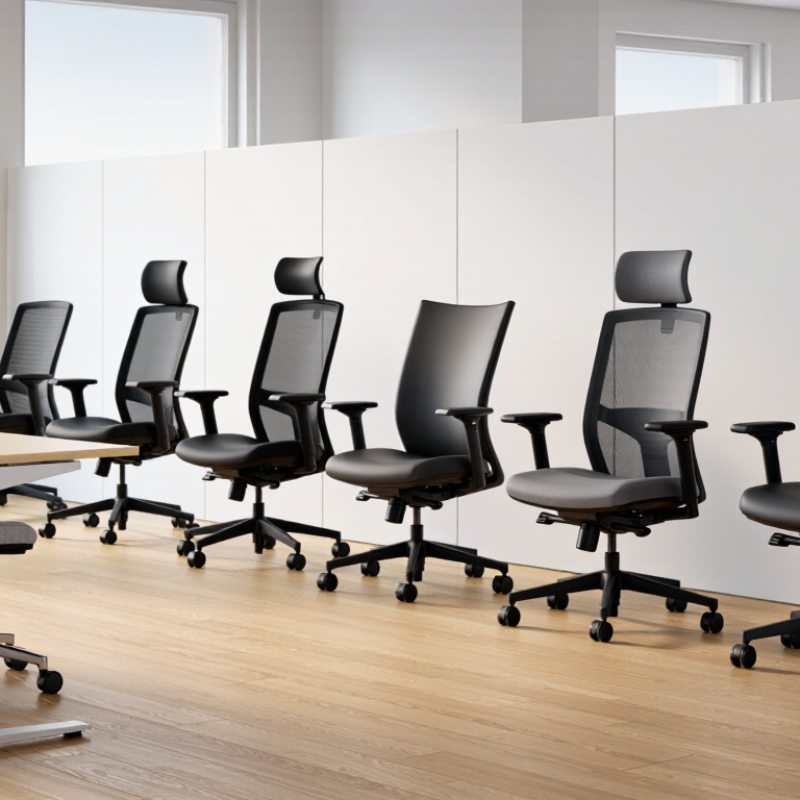
2026 Ergonomic Chair Standards: ANSI/BIFMA X5.1 and EN 1335 Benchmarks
For global buyers, ergonomic claims should begin with measurable standards, not attractive product photos. ANSI/BIFMA X5.1 evaluates general-purpose office chairs through stability, strength, durability, and safety tests. Its testing reflects repeated daily use, including seat loading, backrest force, armrest durability, and caster performance. A chair may look comfortable. That proves little.
EN 1335 provides another important benchmark for European procurement. It addresses chair dimensions, adjustment ranges, stability, and safety. Its framework considers seat height, seat depth, backrest support, and user posture. Buyers should check whether testing covers the relevant chair type and adjustment class. A fixed-height chair cannot serve every desk user equally. That detail is often missed.
Work-related musculoskeletal disorders remain a major workplace concern. Eurofound’s European Working Conditions Survey has repeatedly identified back pain and muscular pain among common worker complaints. The International Labour Organization also reports substantial economic losses linked to occupational injuries and diseases. These findings support practical ergonomic purchasing, not fashionable design. I would request independent test reports, rated user weight, adjustment diagrams, and warranty conditions. One weakness remains: standards cannot measure every person’s comfort. A passing result is not a personal guarantee. Trial seating still matters, especially after several working hours.
2026 Top Ergonomic Office Chairs for Global Buyers? – 2026 Ergonomic Chair Standards: ANSI/BIFMA X5.1 and EN 1335 Benchmarks
Buyer-oriented comparison of measurable ergonomic features, international compliance references, and verification points. Values marked as “recommended buying target” are practical selection guidelines, not automatic certification claims.
| Evaluation Dimension | ANSI/BIFMA X5.1 Reference | EN 1335 Reference | Recommended Buying Target for 2026 | Why It Matters to Global Buyers | Verification Evidence |
|---|---|---|---|---|---|
| Scope and intended use | General-purpose office seating, including chairs used for office work and similar seated activities. | The EN 1335 series addresses office work chairs through dimensional, safety, and test-method requirements. | Commercial office use Specify the intended user group, daily hours, and operating environment. |
Preventing a mismatch between a domestic task chair, 24-hour chair, laboratory chair, and commercial office chair. | Product technical file, intended-use statement, test scope, and configuration list. |
| Seat-height adjustment | Requires functional and durability evaluation of chair components; the standard should not be treated as a single ergonomic seat-height prescription. | EN 1335-1 provides dimensional categories for office work chairs, including adjustable seat-height requirements. | Typical target: approximately 400–520 mm adjustable seat height for broad adult coverage. | Supports a neutral knee angle and allows the user’s feet to rest on the floor or a suitable footrest. | Measured dimensional report, adjustment-range drawing, and operating-cycle test results. |
| Seat depth | Functional performance and durability are evaluated; a universal seat-depth value is not the sole basis for conformity. | Seat dimensions are addressed within the dimensional requirements of EN 1335-1. | Recommended target: about 400–460 mm usable depth, preferably with a sliding seat pan. | Helps users maintain back support without pressure behind the knees. | Usable seat-depth measurement, adjustment diagram, and sample inspection. |
| Seat width | Chair strength, stability, durability, and component performance are evaluated rather than prescribing one universal width. | EN 1335 includes dimensional requirements for office work chairs. | Recommended target: at least 450 mm usable width; wider options may be needed for inclusive procurement. | Improves fit across different body sizes and reduces contact with the arm supports or seat edges. | Dimensional drawing, usable-width measurement, and load-test configuration. |
| Backrest support | Backrest strength, durability, and functional behavior are included among the chair-performance considerations. | Safety and dimensional requirements cover the backrest and related chair functions. | Height-adjustable backrest with lumbar-support adjustment and a recline range of approximately 90°–120°. | Allows the chair to fit different torso lengths and supports posture changes during computer work. | Adjustment-range test, backrest load test, recline-lock test, and user-fit assessment. |
| Arm supports | Arm-support strength and durability are evaluated where arm supports are included in the chair configuration. | Armrest dimensions and safety considerations are addressed where applicable to the chair type. | Height-adjustable arm supports with a width that permits the elbows to remain close to the torso. | Can reduce shoulder elevation and support neutral forearm positioning at the desk. | Armrest adjustment range, vertical-load test, lateral-load test, and interference check with the desk. |
| Stability and overturning | Stability testing is a core performance area, including assessment of the chair under specified loading and positioning conditions. | Safety requirements and test methods address stability and safe operation. | Five-star base or an equivalent stable configuration, with no unacceptable overturning during the applicable test procedure. | Reduces the risk of falls when users recline, reach, or sit near the edge of the seat. | Full stability test report identifying the tested base, casters, seat, and load configuration. |
| Base and casters | Base, caster, and chair-component performance is evaluated through strength and durability testing. | Relevant safety and test requirements apply to the complete chair assembly and its moving components. | Replaceable casters matched to the floor type; five-point base; smooth rolling without excessive play. | Floor compatibility affects noise, mobility, carpet performance, and long-term maintenance cost. | Caster type and dimensions, floor-use declaration, rolling test, and replacement-part availability. |
| Durability and cycle testing | ANSI/BIFMA X5.1 includes durability and strength tests for general-purpose office chairs and their components. | EN 1335-2 specifies safety requirements, while EN 1335-3 specifies test methods for office work chairs. | Request a complete test report rather than relying only on a static load number or marketing statement. | Cycle performance is more useful than a single maximum-load figure when chairs will be used daily. | Independent laboratory report showing test cycles, loads, failures, acceptance criteria, and tested model identity. |
| Static load capacity | Load and strength testing is performed under defined laboratory conditions; test capacity is not identical to a recommended user weight. | EN 1335 test methods use defined loads and procedures for the applicable chair category. | Specify a declared user-weight limit with a safety margin and ensure it matches the tested configuration. | Protects buyers from confusing laboratory test loads with an everyday user rating. | Declared maximum user mass, test-load details, safety factor statement, and warranty terms. |
| Recline and locking mechanism | Mechanism strength, durability, and safe operation are relevant to the complete chair evaluation. | Safety requirements cover the secure operation of adjustable chair functions. | Multi-position recline with controlled resistance, a stable upright position, and an anti-shock return function. | Supports posture variation while reducing sudden backrest movement and user discomfort. | Mechanism-cycle report, lock-position test, anti-shock test, and adjustment instructions. |
| Materials and flammability | ANSI/BIFMA X5.1 is primarily a performance and safety standard; textile flammability may require separate applicable regulations or tests. | EN 1335 conformity does not automatically replace country-specific textile, chemical, or fire requirements. | Declare upholstery composition, foam type, recycled content where claimed, and any separate fire or chemical compliance. | Import requirements vary by destination, building type, and public-procurement rules. | Material declarations, safety data where relevant, textile test reports, and destination-market compliance documents. |
| Ergonomic adjustment checklist | Standards verify defined safety and performance requirements; they do not guarantee that every user will experience the same ergonomic benefit. | EN 1335 provides dimensional and safety benchmarks, not a substitute for individual fit assessment. | Prioritize adjustable seat height, seat depth, backrest height, lumbar position, arm supports, recline tension, and caster selection. | Adjustability generally improves the probability of fitting a diverse international workforce. | Adjustment map, user manual, fitting instructions, and representative user trial. |
| Documentation for cross-border procurement | Request the exact standard edition, laboratory, test scope, model identifier, and tested options. | Identify the applicable EN 1335 part or parts and the chair type covered by the report. | Traceable documentation Keep drawings, reports, declarations, warranty terms, and spare-parts information together. |
Reduces customs, tender, warranty, and product-variation disputes across markets. | Signed declaration, accredited-laboratory report where required, bill of materials, and version-controlled drawings. |
| Recommended procurement decision | Choose chairs with a test report demonstrating the applicable ANSI/BIFMA X5.1 performance areas. | Choose chairs with documentation covering the applicable EN 1335 dimensional, safety, and test-method requirements. | Use a weighted score: fit and adjustability 30%, safety and stability 25%, durability 20%, documentation 15%, serviceability 10%. | Balances user comfort with measurable risk control, lifecycle cost, and international purchasing requirements. | Completed tender scorecard, sample-chair inspection, report review, and signed supplier declaration. |
Related Posts
-
Top 5 Ergonomic Foot Rests for Comfort and Health Benefits?
-

How to Choose the Best Office Storage Lockers?
-
Best Ergonomic Keyboard Trays for Comfort and Productivity?
-

Top Modular Office Cubicles How to Choose the Best?
-

How to Choose Ergonomic Foot Rests for Maximum Comfort?
-
What Is the Best Type of Lounge Area Sofa?