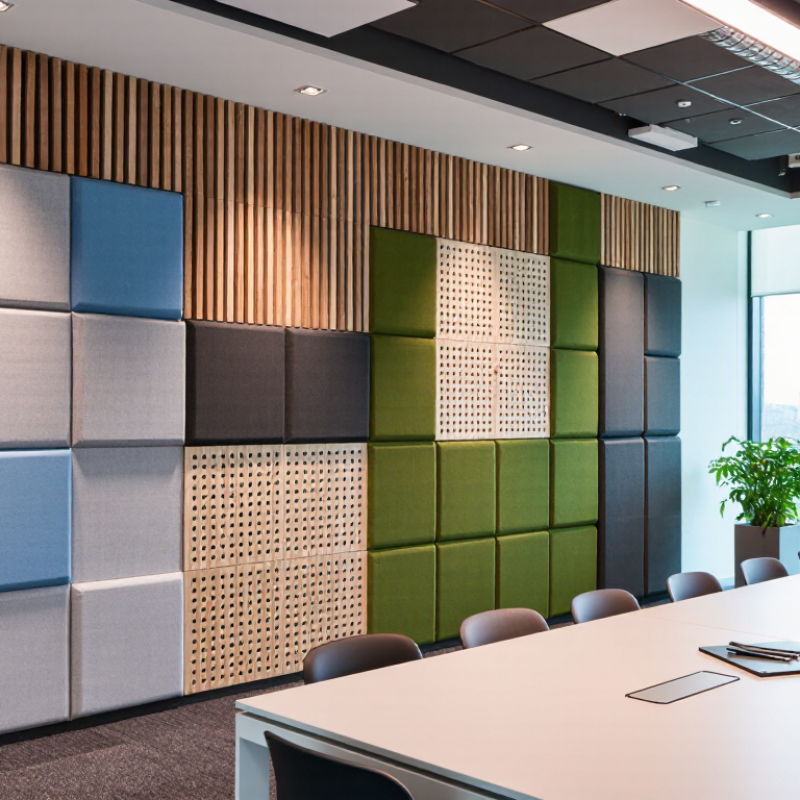
China has become a major sourcing destination for acoustic wall panels, serving offices, schools, studios, hotels, restaurants, and public buildings. Its manufacturers offer PET felt, fabric-wrapped, wood slat, perforated timber, and recycled fiber solutions. Product choice should begin with the room’s purpose, not appearance alone.
Acoustics professor Lily M. Wang explains, “Good acoustics supports communication, learning, and comfort.” That principle matters when comparing Chinese manufacturers and suppliers. Reliable companies should provide laboratory reports, sound absorption ratings, fire-performance information, material specifications, and installation guidance. Look for data based on recognized testing methods, including noise reduction or reverberation performance. A beautiful panel can still perform poorly if the wrong thickness, spacing, or coverage is selected.
Details matter. In a meeting room, panels behind speakers may reduce distracting reflections. In a restaurant, moisture resistance and cleanable fabrics may matter more. PET panels can add color and texture while using recycled content, but “eco-friendly” claims require evidence. Supplier experience also deserves attention. Ask for project photographs, sample pieces, production lead times, packaging details, and after-sales support.
Not every factory is a perfect fit. Some suppliers communicate well but provide limited testing documents. Others offer impressive catalogs yet overlook edge finishing or mounting hardware. That is where buyers must slow down. Compare samples. Check tolerances. Confirm the final wall area.
This guide examines China’s leading acoustic wall panels manufacturers and suppliers through product quality, customization, certifications, pricing, capacity, and service reliability. The market is broad. Careful verification remains essential.
Acoustic wall panels are interior surfaces designed to absorb unwanted sound. They commonly combine porous cores with fabric, wood, or recycled materials. Unlike soundproof barriers, they do not stop every sound from entering or leaving a room. Their main job is controlling reflections inside the room.
In a meeting room, speech can bounce from glass, plaster, and polished floors. These reflections create echo and reduce clarity. Strategically placed panels absorb part of this energy, especially across mid and high frequencies. Conversations then sound less harsh. Voices become easier to follow. Background noise feels less distracting.
Good placement matters more than decoration alone. During room assessments, installers often identify the first reflection points beside speakers and on opposing walls. Ceiling treatment may also help in rooms with hard surfaces. Panel thickness, spacing, coverage, and absorption ratings should match the room’s size and use. A thin decorative panel may improve comfort, but it cannot solve severe low-frequency problems.
Measurements are useful. Yet, real listening still matters. A room can meet a target rating and feel slightly dull. That is an easy mistake. I recommend testing speech from several seats before final installation. Furniture, curtains, and occupancy also change the result. Effective acoustic design balances absorption with natural liveliness, rather than covering every available wall.
China’s acoustic wall panel manufacturers offer practical choices in felt, PET, wood, fabric, and perforated gypsum.
Recycled PET panels are light, cuttable, and suitable for open offices.
Wood slat panels add warmth while combining a veneer face with an absorptive backing.
Fabric-wrapped boards provide softer textures and easier color matching.
Perforated mineral or gypsum panels suit corridors, classrooms, and larger commercial interiors.
Material choice should follow measured acoustic needs, not appearance alone.
ASTM C423 testing reports sound absorption through the Noise Reduction Coefficient and frequency data. Low-frequency performance often remains weaker, especially with thin panels mounted directly on walls.
The 2023 report from MarketsandMarkets estimated the global acoustic panels market at about USD 12 billion, with commercial interiors and construction driving demand. The report also noted growing interest in sustainable materials.
However, market forecasts vary widely, so buyers should inspect test conditions carefully. A beautiful panel can still perform poorly in a noisy room.
Tips:
Ask for laboratory reports, fire-performance documents, and installation details. Check absorption values at 125, 250, 500, 1,000, and 2,000 Hz. Leave an air gap behind panels when possible; it can improve low-frequency absorption.
For offices, combine ceiling treatment with wall panels. In site reviews, I have seen designers overuse hard decorative slats and underestimate speech reflections. That mistake is easy to repeat.
Samples should be tested under real lighting and mounting conditions before bulk production. Industry standards help, but room geometry still decides the final experience.
China Top Acoustic Wall Panels Manufacturers and Suppliers
Reliable Chinese acoustic wall panel suppliers manage quality through repeated checks, not final inspection alone. Production teams inspect incoming fibers, wood strips, adhesives, and backing materials before manufacturing begins. They record thickness, density, color, moisture levels, and surface defects for each material batch. Records matter. Small errors spread quickly across large orders.
During production, workers use calibrated cutting equipment to maintain accurate panel sizes. Supervisors check edges, grooves, bonding strength, and decorative alignment at defined stages. For sound performance, qualified laboratories may test sound absorption under recognized methods. Factory samples can also be compared with approved reference panels. This helps prevent changes in texture or acoustic structure between shipments.
Experienced suppliers usually keep batch numbers from raw materials through packaging. That traceability supports faster investigation when a panel arrives damaged or differs from the approved sample. Packaging teams use corner protection, moisture barriers, and carton inspections before loading. However, no process is perfect. Some batches still require rework because of uneven color, weak bonding, or cutting mistakes. A trustworthy supplier reports these problems rather than hiding them. Production schedules may slow slightly, but honest correction protects installation quality and long-term customer confidence.
Reliable acoustic wall panel suppliers commonly verify sound absorption performance across standardized octave-band center frequencies. The 125–4000 Hz range is widely used in laboratory testing under methods such as ISO 354 and ASTM C423. Actual absorption results depend on panel thickness, density, surface finish, installation, and test configuration.
Evaluating Chinese acoustic wall panel manufacturers starts with the project, not the catalogue. Start with the room. A classroom needs speech clarity, while a restaurant may need stronger reverberation control and cleanable surfaces. Define target noise levels, panel thickness, fire rating, humidity exposure, and installation method before requesting quotations. Fortune Business Insights estimated the global acoustic panels market at about USD 10.84 billion in 2023, with continued growth through 2032. This expansion increases supplier choices, but not necessarily supplier quality.
Ask manufacturers for third-party reports based on ISO 354 or ASTM C423. These tests support comparisons of sound absorption, including NRC or weighted absorption values. Request EN 13501-1 fire classification when European compliance is required. Also check formaldehyde and VOC test results for occupied interiors. A supplier should explain test conditions clearly.
“Soundproof” is often used too loosely. It may describe absorption, not sound insulation.
Samples matter. Examine edge cuts, fabric tension, colour consistency, and backing density under real lighting. Then compare the sample with the approved production batch. My own tender reviews have exposed a recurring mistake: buyers verify the laboratory report but ignore moisture storage and packaging damage. Request factory photos, batch records, carton specifications, and a pre-shipment inspection. Confirm minimum order quantities, replacement procedures, lead times, and production capacity in writing.
A small pilot order can reveal weaknesses. It costs more initially. That gap matters. Suppliers serving complex projects should provide shop drawings and installation guidance, although technical support can vary considerably between factories.
China’s acoustic wall panel manufacturers support more than bulk purchasing. They manage samples, technical drawings, production, inspection, and export documents. Grand View Research estimated the global acoustic panels market at about USD 10.5 billion in 2023. It also projected steady growth through 2030. This expansion increases demand for reliable Chinese suppliers.
A practical order should specify panel size, thickness, core material, surface finish, color, quantity, and installation method. Request a physical sample before approving mass production. Confirm the minimum order quantity, lead time, carton protection, HS code, and Incoterm. Custom options may include PET felt patterns, fabric wrapping, perforated wood, and printed surfaces. However, visual customization can change absorption performance. That detail is often missed.
Certification requires careful verification. ISO 354 laboratory results can document sound absorption, while ASTM E84 or EN 13501-1 may address fire performance, depending on the destination. A 2024 report from MarketsandMarkets valued the acoustic panels market at over USD 10 billion and identified commercial construction as a major application area. Export support should include packing lists, commercial invoices, certificates of origin, test reports, and pre-shipment inspection. Ask whether documents match the exact production batch. A certificate alone proves little. In practice, small wording differences can delay customs clearance. Mistakes still happen. A responsive supplier should explain corrective actions, not hide them.
The following table summarizes commonly available product specifications, purchasing conditions, compliance documents, and export services in China's acoustic wall panel supply market. Exact figures may vary according to material, finish, project quantity, and technical requirements.
| Product or Service Dimension | Commonly Available Options | Typical Technical or Commercial Data | Applicable Standards or Documents | Typical Ordering Information | Export Support in China |
|---|---|---|---|---|---|
| Core Material | Polyester acoustic board, mineral wool, glass wool, perforated MDF, slatted wood, and PET felt systems. | PET panels are commonly produced from recycled polyester fibers; mineral wool and glass wool systems generally provide higher sound absorption when combined with an acoustic fabric finish. | Product composition declaration, safety data sheet where applicable, and project-specific material specifications. | Confirm density, thickness, facing material, edge treatment, and installation method before quotation. | Material descriptions and packing lists can be prepared in English for customs and project documentation. |
| Standard Panel Sizes | Rectangular wall panels, ceiling baffles, decorative slats, tiles, clouds, and modular acoustic screens. | Common panel dimensions include approximately 600 × 600 mm, 1200 × 600 mm, 2400 × 600 mm, and 2440 × 1220 mm. Custom sizes are also widely available. | Dimension drawings, tolerance information, installation layouts, and product data sheets. | State required length, width, thickness, quantity, and allowable dimensional tolerance. | Export cartons, pallets, and container-loading plans can be arranged according to panel dimensions. |
| Panel Thickness | Thin decorative panels, medium-thickness wall absorbers, and high-performance composite systems. | Typical thicknesses range from 9 mm to 50 mm for decorative PET or fabric panels; thicker assemblies may include an air cavity or secondary backing layer. | Product technical sheet and acoustic test report identifying the tested thickness and mounting condition. | Thickness should be selected together with the target reverberation control and available wall depth. | Suppliers can provide thickness-based packing calculations and shipping-volume estimates. |
| Sound Absorption Performance | Wall-mounted absorbers, ceiling absorbers, suspended baffles, and composite panels with air gaps. | Acoustic performance is normally reported by sound absorption coefficient or weighted absorption coefficient. Results depend on frequency, thickness, backing, and mounting distance. | ISO 354, ASTM C423, or equivalent laboratory test methods may be referenced, depending on the target market. | Request the complete test configuration rather than relying only on a single absorption value. | English test reports and technical submittals can commonly be included in export project files. |
| Surface Finish and Color | Polyester felt, acoustic fabric, natural wood veneer, melamine finish, paint finish, printed graphics, and perforated decorative surfaces. | Standard colors are usually selected from supplier color cards; custom colors can be matched to a supplied reference or recognized color system. | Color card, finish sample, surface-care instructions, and batch color approval record. | Approve a physical sample where color consistency, texture, or wood grain is important. | Samples can be labeled, photographed, and packed separately for buyer approval before mass production. |
| Customization Capability | Custom dimensions, CNC patterns, logos, geometric layouts, printed artwork, edge shapes, and acoustic artwork. | Customization normally requires CAD or vector artwork, production drawings, color references, and confirmation of minimum line width or pattern detail. | Approved drawing, artwork authorization, sample approval, and revision-controlled quotation. | A prototype or pre-production sample may be required before full-volume manufacturing. | Digital drawings can be exchanged in common formats such as PDF, DWG, AI, or DXF, subject to supplier capability. |
| Fire Performance | Fire-rated fabric, treated PET, mineral wool, glass wool, and fire-retardant backing systems. | Fire performance varies by complete assembly, including core, facing, adhesive, frame, and mounting method. It should not be inferred from the core material alone. | EN 13501-1, ASTM E84, ASTM E136, or local fire classifications may be requested according to the destination market. | Specify the required fire class and confirm whether the report covers the exact proposed construction. | Suppliers may provide translated fire reports, declarations, and sample labels for customs or project approval. |
| Environmental and Indoor-Air Documents | Low-emission adhesives, recycled PET content, formaldehyde-controlled wood products, and recyclable components. | Environmental claims should be supported by product-specific evidence, such as recycled-content information or emissions testing. | GREENGUARD-type emissions documentation, formaldehyde test reports, FSC-related documents for eligible wood materials, or EPD documentation where available. | Confirm whether the document applies to the exact material, finish, adhesive, and production site. | Compliance files can be organized in English for green-building submissions and import reviews. |
| Minimum Order Quantity | Samples, small trial orders, standard-color production, and large project orders. | MOQ is product-dependent. Standard panels may be available in small cartons, while custom colors, printed designs, and special tooling usually require a higher quantity. | Quotation, pro forma invoice, sample invoice, and customization confirmation. | Ask separately for sample MOQ, standard-product MOQ, and custom-product MOQ. | Mixed sizes or colors may be consolidated when packaging and production conditions permit. |
| Sampling and Approval | Color swatches, material chips, full-size samples, corner samples, and installation mock-ups. | A sample is normally used to verify color, texture, thickness, edge quality, pattern accuracy, and mounting details before production. | Sample approval sheet, signed drawing, inspection checklist, and approved reference sample. | Sample charges and freight are commonly quoted separately and may be credited against a later bulk order by agreement. | Samples can be shipped by international courier with commercial invoices and non-hazardous material descriptions. |
| Production Lead Time | Stock items, standard production, custom colors, printed panels, and engineered project systems. | Stock or simple standard items may be ready sooner; custom production commonly requires several weeks after drawing, color, and payment approval. | Confirmed production schedule, approved drawings, inspection plan, and shipment booking record. | Lead time should be calculated from final approval of specifications rather than from the initial inquiry date. | Suppliers may coordinate factory completion, pre-shipment inspection, container loading, and export booking. |
| Quality Inspection | Visual inspection, dimensional inspection, color comparison, quantity counting, packaging inspection, and third-party inspection. | Inspection points can include panel size, thickness, surface defects, pattern alignment, color consistency, accessories, and carton markings. | Inspection checklist, production photos, factory inspection report, and pre-shipment inspection report. | Agree on acceptance criteria and allowable defects before production begins. | Inspection agencies or buyer-appointed inspectors can usually be accommodated by prior arrangement. |
| Installation System | Adhesive, mechanical clips, Z-clips, concealed profiles, direct screws, suspension wires, and timber or metal subframes. | The fixing method depends on panel weight, wall substrate, required air gap, access for maintenance, and local building requirements. | Installation manual, fixing schedule, shop drawings, anchor recommendations, and maintenance instructions. | Confirm whether accessories are included and whether the quotation covers installation labor or only materials. | Hardware can be counted, labeled, and packed by installation zone or room to support overseas site work. |
| Packaging and Protection | Export cartons, foam or paper separators, moisture protection, pallets, corner guards, and reinforced wooden cases where required. | Packaging should protect panel edges, corners, surfaces, and decorative finishes from compression, abrasion, and moisture during transport. | Packing list, carton marks, pallet details, fumigation documentation where applicable, and photographic packing records. | Confirm carton dimensions, gross weight, net weight, and quantity per package before freight booking. | Packing can be adapted for courier, LCL, or full-container shipment and for destination-specific labeling requirements. |
| Trade Terms and Payment | EXW, FOB, CIF, and other Incoterms agreed between the parties. | The selected term determines which party handles inland transport, export clearance, ocean freight, insurance, and destination delivery. | Pro forma invoice, commercial invoice, sales contract, and Incoterms reference. | Confirm currency, deposit arrangement, balance payment, bank charges, validity period, and quotation exclusions. | Export quotations can include port of loading, estimated shipping volume, HS-code reference, and document-handling scope. |
| Export Documentation | Commercial invoice, packing list, bill of lading or airway bill, certificate of origin, and insurance certificate where required. | Document requirements depend on destination country, transport mode, customs classification, and buyer or project requirements. | Certificate of origin, material declaration, test reports, inspection documents, and customs-related paperwork where applicable. | Provide the consignee, notify party, destination port, product description, and document instructions before shipment. | Export suppliers commonly coordinate with freight forwarders and customs brokers for shipment documentation. |
| After-Sales and Replacement Support | Installation guidance, replacement panels, spare accessories, damage claims, and technical clarification. | Support depends on the sales contract and may require photographs, carton numbers, batch information, and installation records. | Warranty terms, claim procedure, replacement-part list, and maintenance guide. | Keep approved samples, purchase records, drawings, and batch details for future matching or expansion orders. | Replacement quantities may be consolidated with subsequent export shipments to reduce freight cost. |