
How to Choose a Motorized Aluminum Roller Shutter in 2026?
Choosing a Motorized Aluminum Roller Shutter in 2026 requires more than comparing colors and remote controls. The right system must fit the opening, climate, security needs, and daily routine. A shutter covering a sunny shopfront faces different demands from one protecting a bedroom window. Small details matter, including slat thickness, guide-rail depth, motor noise, and access for future servicing. Yet product pages often hide these practical differences.
This guide examines the decision through real installation questions. Measure the opening at several points, because older walls rarely remain perfectly square. Check wind exposure, rainfall, dust, and available power before choosing a motor. Ask whether the control system supports manual emergency operation and safe stopping. Manufacturer test reports, clear warranty terms, and traceable component information deserve more attention than impressive advertising. A qualified installer should confirm structural fixing, electrical suitability, and local safety requirements.
There is no universal best shutter. A heavier curtain may improve strength, but it can increase cost and motor load. Smart-home integration sounds convenient, although compatibility can change faster than expected. I would not choose a model from a brochure alone. Touch the sample, listen to the motor, inspect the bottom seal, and request maintenance guidance. This article will help readers compare durability, insulation, security, automation, installation quality, and long-term value with a more critical eye. Some recommendations may need adjustment after site inspection. That is normal.
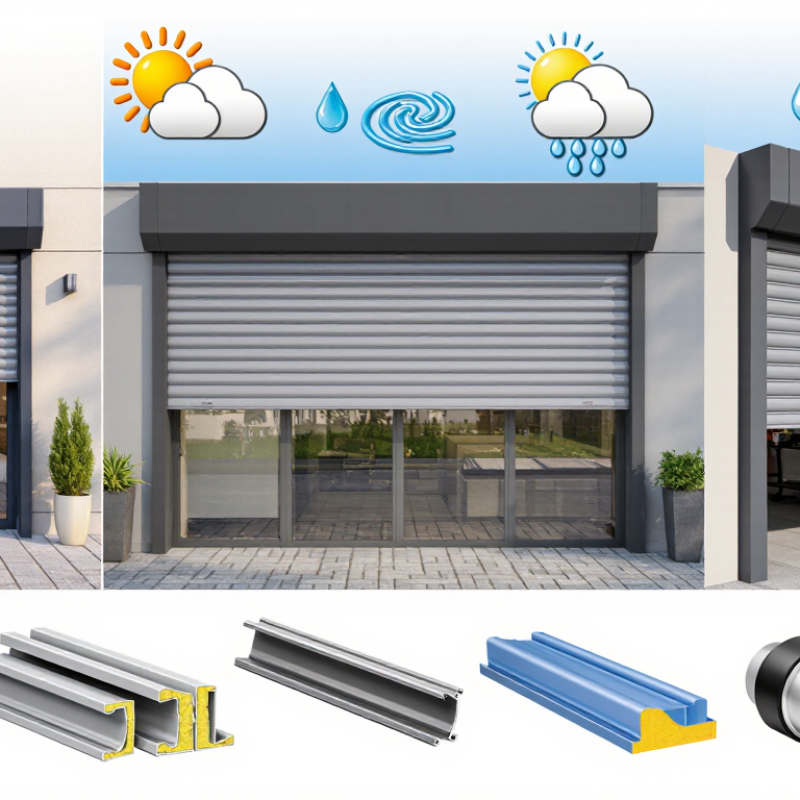
Define Your Security, Insulation, and Privacy Requirements
Choosing a motorized aluminum roller shutter starts with defining the threat, not selecting a finish. Do you need privacy at night, stronger resistance against forced entry, or protection from harsh weather? Specify a certified security class, robust guides, and a motor with manual override. EN 13659 provides performance classifications for external shutters, including wind resistance. Do not treat a heavier curtain as automatic proof of better security.
Insulation deserves equal attention. The U.S. Department of Energy reports that windows can cause 25–30% of residential heating and cooling energy use. An external shutter can reduce solar heat gain and limit night-time heat loss, especially when the curtain closes tightly against the frame. Ask for tested thermal data under EN ISO 10077-1 methods. Slat shape, foam filling, side gaps, and installation quality all matter. Small gaps matter more than many buyers expect.
Privacy is more precise than “fully closed.” Choose slats that block direct sightlines without making the room feel sealed. Add timer control, indoor sensors, and quiet operation for bedrooms. The International Energy Agency’s Buildings 2023 report identifies buildings as responsible for about 30% of global final energy use. That makes control strategy important, not decorative. In practice, installers often find that customers overspecify motors but overlook sunlight direction. I would reconsider that habit. A smaller motor with accurate scheduling may deliver better comfort than maximum power. Test the shutter at dusk, during strong wind, and after repeated cycles before approving the installation.
How to Choose a Motorized Aluminum Roller Shutter in 2026? - Define Your Security, Insulation, and Privacy Requirements
| Requirement | Recommended Specification | Suitable Application | What to Check Before Purchase |
|---|---|---|---|
| Basic privacy | Solid or opaque aluminum slats with minimal gaps; full-height closure | Bedrooms, bathrooms, street-facing windows | Confirm that the curtain blocks direct sight lines when fully closed and that side guides do not leave visible openings. |
| Enhanced privacy and daylight control | Perforated or adjustable slats with controllable opening positions | Living rooms, offices, retail spaces | Check whether the slat design provides ventilation and daylight without allowing an unwanted view into the room. |
| Standard residential security | Interlocking aluminum slats, reinforced side guides, automatic stop function | Ground-floor windows and doors | Look for a rigid bottom rail, secure guide channels, obstruction detection, and resistance to manual lifting. |
| Higher security exposure | Heavier-gauge profiles, reinforced end locks, strengthened bottom rail, concealed fixings where practical | Unoccupied properties, accessible storefronts, vulnerable openings | Ask for independently verified test results if a formal security classification is required; do not rely only on material thickness. |
| Warm-climate solar control | Light-colored, powder-coated aluminum slats; external installation preferred | Sun-exposed windows and west-facing façades | External shutters can reduce solar heat gain before sunlight reaches the glazing. Select a finish suitable for local UV exposure. |
| Cold-climate insulation | Foam-filled aluminum slats with sealed side guides and a well-fitted top box | Bedrooms, offices, and frequently occupied rooms | Request the complete shutter assembly’s thermal data where available; slat insulation alone does not determine whole-window performance. |
| Noise reduction | Dense interlocking slats, cushioned guides, and correctly sealed installation | Homes near roads, railways, or busy commercial areas | Obtain a tested sound-reduction value for the complete window-and-shutter system; performance varies significantly by installation. |
| Large opening | Motor and curtain sized according to opening width, curtain weight, wind load, and roll diameter | Wide windows, patio doors, commercial openings | Provide exact opening dimensions and local wind conditions. Oversized curtains may require a tubular motor or a heavier-duty drive system. |
| Wind exposure | Wind-rated slats, reinforced guides, and secure end stops selected for the site | Coastal, exposed, or elevated façades | Use the applicable local standard and project wind-load calculation. A generic wind rating may not suit every building location. |
| Frequent daily operation | Motor rated for the expected duty cycle, with thermal protection and adjustable limit switches | Offices, hospitality, retail, and multi-user buildings | Compare the stated operating cycles per hour or day, motor noise, service access, and replacement-part availability. |
| Low-maintenance operation | Corrosion-resistant aluminum, durable powder coating, accessible inspection cover | Coastal and humid environments | Check coating quality, drainage, fastener material, cleaning requirements, and whether the motor can be serviced without removing the full shutter. |
| Child and pet safety | Wall-mounted control at a safe height, wireless control with secure pairing, obstacle detection where supported | Family homes, schools, care facilities | Avoid dangling cords, verify automatic reversal or stop behavior, and follow the safety requirements applicable in the installation country. |
| Smart-home integration | Compatible dry-contact, wired bus, radio, or gateway interface | Automated homes and managed buildings | Confirm protocol compatibility, local manual override, power-failure behavior, cybersecurity updates, and whether a separate gateway is needed. |
| Power-failure access | Manual override, emergency crank, battery backup, or an alternative escape opening | Bedrooms, required exits, buildings with unreliable power | Ensure the selected solution does not block a required means of escape and test the backup method after installation. |
| Aesthetic coordination | Powder-coated finish, concealed or integrated head box, matching guide rails and bottom rail | New construction and façade renovations | Review the visible box size, side-guide width, color sample, and clearance around window handles and doors. |
| Regulatory compliance | Documented electrical safety, installation instructions, product declarations, and applicable shutter performance testing | All residential and commercial projects | Confirm compliance with local electrical, building, fire, accessibility, wind, and emergency-egress requirements before ordering. |