How to Choose the Best Cosmetic Bed for Your Business?
Choosing the right Cosmetic Bed can shape every client’s experience, from the first consultation to the final treatment photograph. It also affects how confidently your team works during long appointments. A beautiful bed may attract attention, but appearance alone cannot support a busy clinic.
Cosmetic equipment specialist Sarah Cooper says, “A professional bed should protect the client’s comfort and the practitioner’s posture at the same time.” Her point deserves practical attention. A narrow bed may look elegant, yet it can limit client movement and make positioning difficult. A weak motor may interrupt treatment. Poor cushioning can create pressure points after only thirty minutes.
Think about your real treatment room. Is the floor level? Can staff move around the bed without twisting? Does the hydraulic or electric system operate quietly? Check the safe working load, adjustment range, upholstery quality, cleaning resistance, and warranty terms. These details often matter more than polished product photographs.
Comfort is measurable.
Your choice should also match your business model. A facial studio may need a compact Cosmetic Bed with simple adjustment features. A clinic offering advanced treatments may require stronger support, removable sections, and precise positioning. Do not buy the most expensive model automatically. Expensive does not always mean suitable.
There is room for honest reflection. Many buyers focus on client comfort and overlook practitioner fatigue. Others choose a low-cost bed, then discover that repairs and downtime reduce profits. The best decision connects safety, durability, workflow, and budget. This guide will help you compare those factors clearly before placing an order.
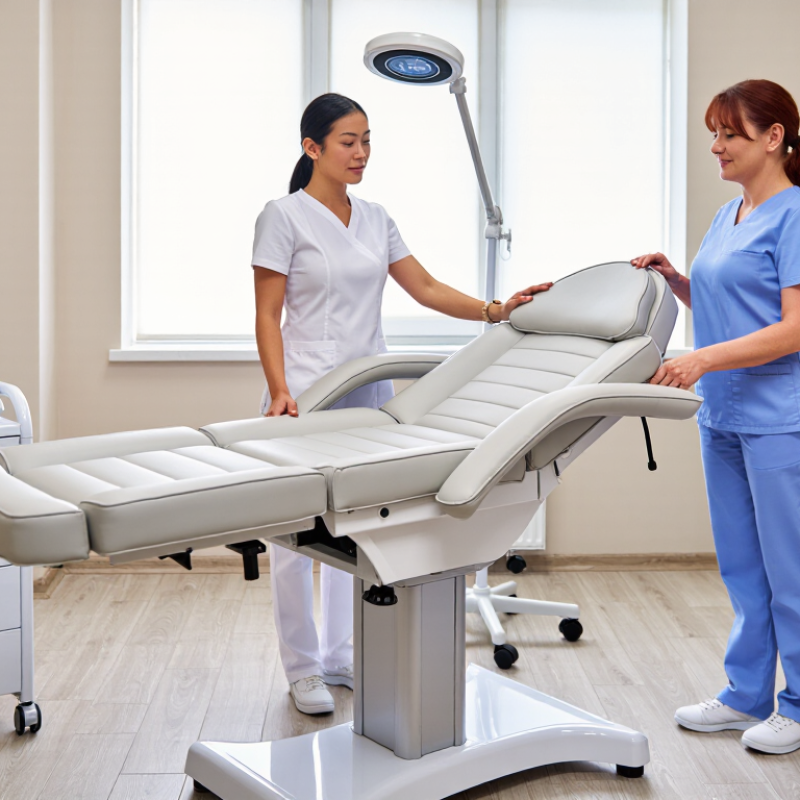
Match Bed Type to Treatments: Facial, Massage, Laser, or Multi-Use
How to Choose the Best Cosmetic Bed for Your Business?
Match Bed Type to Treatments: Facial, Massage, Laser, or Multi-Use
Choosing a cosmetic bed starts with your treatment menu, not its appearance. A facial bed should provide steady back support, adjustable height, and comfortable leg positioning. These details matter during cleansing, exfoliation, and mask application. A quiet motor also helps maintain a calm client experience. Easy-to-clean upholstery is essential when creams, oils, and water are used daily.
Massage treatments require stronger construction and reliable weight capacity. Look for firm support, smooth height adjustment, and padding that protects pressure points. A very soft surface can feel comfortable at first. It may reduce control during deeper techniques. For laser treatments, prioritize stable positioning, non-reflective surfaces, and materials suited to the equipment supplier’s instructions. Keep cables organized. Safety should never depend on guesswork.
A multi-use bed can save space for growing businesses. However, flexibility often brings compromises. I once assumed one adjustable bed could serve every treatment equally well. In practice, therapists may dislike its limited cushioning or narrow working angle. Review your busiest services, room size, cleaning routine, and staff preferences before buying. Test the bed with a real treatment setup, not just an empty showroom display. Small discomforts become expensive problems when repeated every day.
Set Ergonomic Targets: 60–90 cm Height and 3–5 Adjustable Sections
Choosing a cosmetic bed starts with the practitioner’s working posture, not upholstery color. In treatment rooms, I have seen poorly positioned beds force repeated shoulder lifting and wrist bending. These small errors become tiring during a fully booked day.
Set the working height between 60 and 90 cm. This range gives many practitioners room to keep elbows near the body while treating the face, shoulders, or legs. A 2023 U.S. Bureau of Labor Statistics report recorded musculoskeletal disorders in a significant share of days-away-from-work cases, showing why ergonomic planning deserves attention. The exact height still depends on the practitioner’s stature and treatment style. Measure it.
Choose three to five adjustable sections for practical flexibility. A backrest, leg section, and central platform can support facial treatments, waxing, massage, and body procedures. More sections may improve positioning, but they can also increase setup time and cleaning points. NIOSH ergonomic guidance emphasizes reducing awkward postures, excessive reaching, and static loading. Use that principle during a real treatment simulation. Lie on the bed. Reach for tools. Check your shoulders. It may feel different than expected.
Height adjustment should be smooth and stable, especially when clients turn or sit upright. The base must leave enough knee clearance for close work. I would also test the lowest setting with shorter staff members, because a 90 cm maximum alone proves little. Ergonomics is measurable, but never perfectly universal.
How to Choose the Best Cosmetic Bed for Your Business? - Set Ergonomic Targets: 60–90 cm Height and 3–5 Adjustable Sections
| Business Application | Recommended Working Height | Recommended Adjustable Sections | Typical Backrest Range | Suggested Working Load | Recommended Width | Ergonomic Reason |
| Facials and Skin Treatments | 65–80 cm | 3 sections | 0–70° | At least 150 kg | 70–75 cm | Supports close facial work while allowing the client to recline comfortably. |
| Massage and Body Treatments | 60–75 cm | 2–3 sections | 0–45° | At least 200 kg | 70–80 cm | A lower height improves therapist posture during manual bodywork and transfers. |
| Eyelash and Brow Services | 70–85 cm | 3 sections | 15–55° | At least 150 kg | 70–75 cm | A stable upper-body position helps maintain accurate, detail-oriented work. |
| Waxing and Hair-Removal Services | 60–80 cm | 3 sections | 0–60° | At least 180 kg | 70–80 cm | Height flexibility helps technicians reach different treatment areas without excessive bending. |
| Advanced Aesthetic Procedures | 70–90 cm | 4–5 sections | 0–80° | At least 200 kg | 70–80 cm | More sections improve positioning, access, and client support during complex procedures. |
| Multi-Service Beauty Studio | 60–90 cm | 4 sections | 0–75° | At least 200 kg | 70–80 cm | A broad adjustment range makes one bed suitable for multiple treatments and therapist heights. |
Selection Checklist: Confirm the stated working load, adjustment range, section locking system, upholstery cleanability, base stability, and clearance for stools or treatment equipment before purchase.
Verify Safety Ratings: EN 60601-1, CE/UL Marks, and 150+ kg Capacity
Choosing a cosmetic bed begins with safety, not upholstery or motor speed. EN 60601-1 addresses basic safety and essential performance for applicable medical electrical equipment. Confirm whether the bed falls within its scope. A CE mark should include a valid Declaration of Conformity, not only a printed logo. For the US market, verify whether a UL mark comes from an accepted certification body. Labels are not enough.
Capacity needs careful interpretation. A 150+ kg rating should cover the client, operator pressure, accessories, and movement. Ask for the tested safe working load, not only the static limit. During an inspection, raise and lower the bed with weight applied. Watch for frame flex, unusual noise, and unstable casters.
The WHO Global Atlas of Medical Devices identifies more than two million medical device types, showing why documentation matters during procurement. Cosmetic equipment may follow different regulatory pathways, so request written scope confirmation.
Tips: Check EN 60601-1 test reports, certification numbers, and the manufacturing date. Confirm electrical input, emergency lowering, pinch-point protection, and cleaning resistance. A 2023 European Commission safety approach also stresses traceable technical documentation. Do not rely on supplier claims alone. I would also leave a margin above 150 kg for real treatment conditions. That may increase cost, but the cheaper assumption can fail under repeated daily use.
Prioritize Hygiene: Seamless PU Upholstery and Disinfectant Resistance
How to Choose the Best Cosmetic Bed for Your Business?
A cosmetic bed should support treatment quality and daily hygiene. Seamless PU upholstery is a practical choice for busy treatment rooms. It creates fewer places for lotion, skin debris, and moisture to collect. Smooth surfaces also make wiping more consistent after every client.
Choose upholstery with documented resistance to your approved disinfectant. Not every PU surface reacts well to strong chemicals. Repeated exposure may cause cracking, fading, or a sticky finish. Ask for test information, cleaning instructions, and recommended contact times. In real use, edges and stitching often receive less attention. That is where problems can begin. Small gaps matter.
Tips: Wipe the bed immediately after each treatment. Use a soft, non-abrasive cloth. Do not spray heavily around controls or adjustment joints. Test the disinfectant on a hidden area before regular use. Follow the product’s instructions, even when the surface appears durable. A quick visual check can reveal early swelling, peeling, or discoloration.
A well-designed bed should have sealed seams and minimal exposed hardware. These details reduce cleaning effort during busy appointments. Adjustable sections should remain easy to access without creating deep crevices. I have found that staff sometimes clean what they can see, not what they can reach. That habit needs review. Hygiene depends on the upholstery, the design, and the discipline of the team using it.
Compare Total Cost: Motors, Warranty, Service, and Lifetime Value
Choosing the best cosmetic bed requires more than comparing purchase prices. A low-cost model may use weaker motors, creating slower adjustments and frequent interruptions. Test every movement: backrest, leg section, height, and tilt. Listen for unusual noise. A smooth motor usually supports better daily workflow and patient comfort.
Warranty terms deserve close attention. Check coverage length, motor exclusions, response times, and replacement procedures. A five-year frame warranty means little if electrical parts receive only limited protection. Service availability also affects total cost. Ask whether technicians are local, how quickly parts arrive, and whether staff can receive basic maintenance training. In a busy treatment room, one unusable bed can delay several appointments.
Tips: Calculate lifetime value, not only the invoice. Add expected repairs, installation, delivery, energy use, and downtime over five years. Record each estimate in a simple spreadsheet. Then compare the cost per working day. Experience shows that reliable service often matters more than a small initial saving. Still, predictions are imperfect. Usage may change, and repair costs can surprise you. Leave room in the budget for that uncertainty. A comfortable bed that remains dependable can protect workflow, staff effort, and long-term revenue.